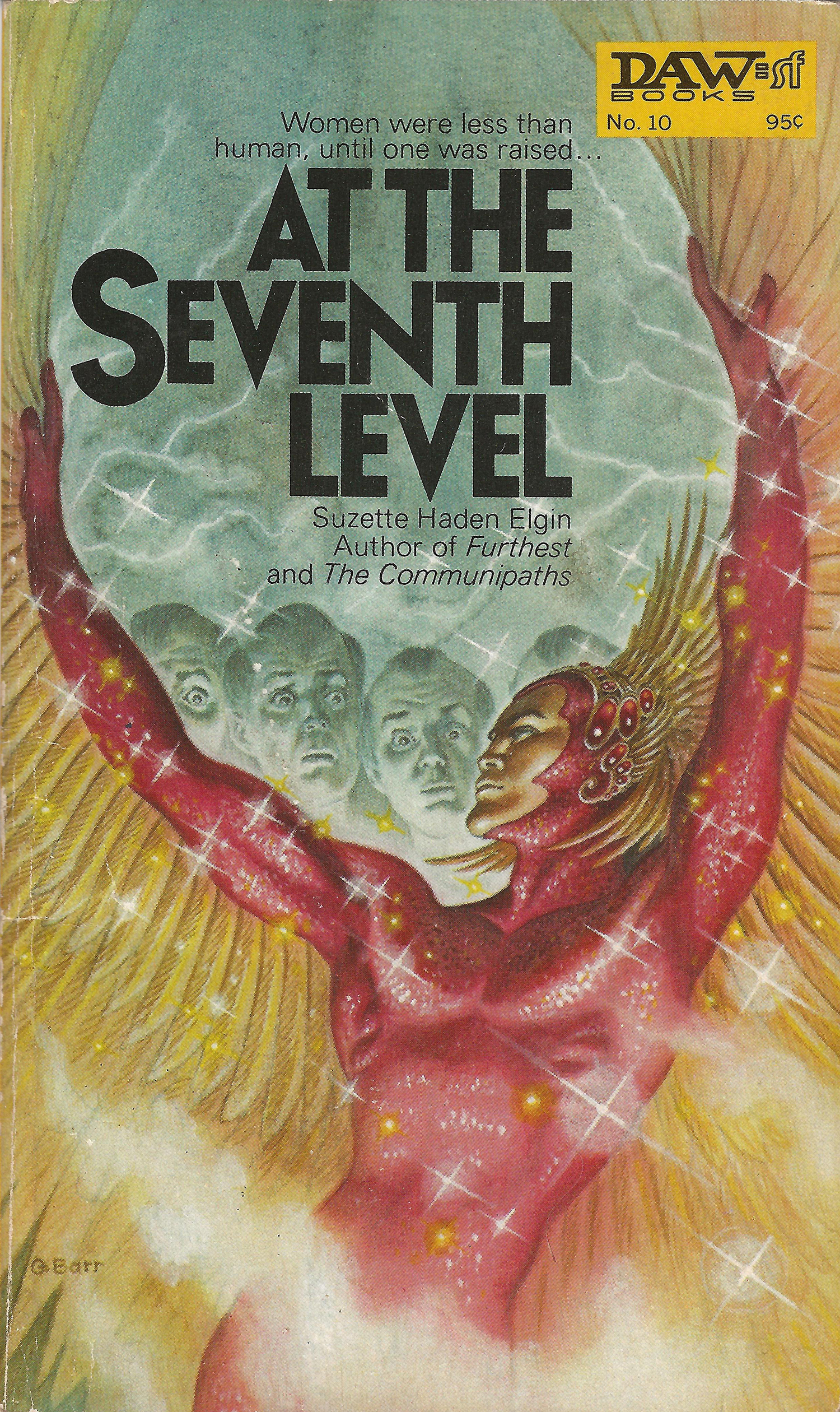
At the Seventh Level
Author: Suzette Haden Elgin
Published: 1972 by DAW
Cover Artist: George Barr (frontispiece and interior art also by George Barr)
Publisher Blurb: Sexual chauvinism was the foundation of that world's structure
Coyote Jones had never heard of Abba until he was assigned there. It was a remotely beautiful world, but one which had been admitted to the society of civilized planets only after it had made concessions on its degrading treatment of women. Until then, women were considered as not human, as a sort of necessary beast, but not more.
The concessions had been slight--but as a result one brilliant female, Jacinth, had risen to the very top of that strange society, to the Seventh Level. Thereby she had become the spiteful target of male fury, female envy, and finally of a deviously evil plot that might cost the world its status.
What Coyote Jones found on Abba, the sensuality of the surface, the sexual horror beneath, and the meaning of human dignity, is a novel worthy of the talens of the most gifted new SF writer since Samuel R. Delany and Roger Zelazny.
Notes: At the Seventh Level is the third book in the Coyote Jones series, following Furthest (1971) and followed by Star-Anchored, Star-Angered (1979).
This is a fix-up novel that opens with two short stories ("For the Sake of Grace", originally published in 1969 by Mercury Press, and "The Roll of Iambs and the Clang of Spondees"), which establish the world of Abba and the character Jacinth, and then lead into a novella featuring Coyote Jones (the weakest part of the book); the book concludes with another short story ("Modulation in All Things"), which takes us back to Jacinth.
There isn't much between the short stories and novella to tie it into a cohesive whole-- a flaw familiar to many fix-ups-- so it's better to think of this is a short fiction collection. Consistency in world-building isn't great. For example, at one point it's called out that the people of Abba aren't human. Due to convergent evolution, they look human. Everywhere else in the book they are human. Like the other novels in this series, Elgin does a lot of telling instead of showing. A handful of events don't really make sense. Interesting ideas and the establishment of an interesting planet aren't fully realized.
As a sort of warning, I doubt this book would be publishable today for its stereotypical portrayal of Arab Muslim cultures. While sexism the world over needs to be criticized and changed, obviously, I don't think this representation has much depth or research put into it. Furthermore, as feminist literature it's subpar at best. Elgin portrays a wildly sexist culture with a lot of avenues for plot development, but most of the story is from the viewpoint of a man who isn't particularly sensitive (Coyote Jones is damn insufferable and completely incompetent for the entire series he features in); what parts aren't from Coyote's perspective are still usually from other male perspectives. The short stories with Jacinth, usually told from male viewpoints, at least give Jacinth a little agency, but in the novella we take a huge step back even with her. And the goofy, cartoony conclusion of the novella does nothing to disrupt the sexism in this culture even a little. I try to keep in mind when reading 'feminist' literature of this era that the bar was incredibly low so quality is very uneven; even looking at some of the other books published by DAW around this same time, we see stories so outrageously sexist that it's hard to fault Elgin, even if by today's sensibilities this would be considered very poor feminist lit. And as beautiful as George Barr's art is, the fact that the interior illustrations are predominantly of sexualized, barely-dressed women in vulnerable poses doesn't help. I would suggest anyone reading this today go into the book with its context in mind and not get their hopes up.
As much as I criticize these novels, this largely stems from the fact that Elgin really did have good setups for them, she asked interesting questions, she established a good speculative foundation for her 'psibilities' based on linguistics, and even some of her worlds come across as being so beautiful and ripe for exploration. So the flat, rushed, and incomplete final product is more disappointing than it would be for a more run of the mill series.
Summary: Because this reads better as a short fiction collection, I summarize it that way here.
"For the Sake of Grace" (also called "For the Love of Grace" in the table of contents) - The Khadilh, administering his orchard on a colony world far from his home Abba, receives an alert that something noteworthy has happened in his household. Soon the full report follows that his wife has behaved oddly and offensively at a religious festival, and he decides to return home to address the matter personally. Of course, if she's at fault it will be up to the Women's Discipline Unit to drug or otherwise punish her, but he must make the decision on what is merited. What could cause his wife to act in such a manner, disrespecting a Poet-- the holiest and most prestigious office on Abba, admitting only the most talented and denying all others to its study? With every one of their own five sons accepted into various Levels of the Poets, the Khadilh's wife should know better than most not to offend a Poet. His eldest son has ensured that his wife has been kept drugged while the family has awaited the Khadilh's return; now she's restored and the truth comes out that his wife was attempting to protect Jacinth, their twelve year old daughter, from the Poet's influence. Jacinth has ambitions to become a Poet herself, and after the incident at the festival she declared her intention to the University. Jacinth is now locked into a course that the Khadilh and his wife are certain will end in tragedy. Becoming a Poet is the only professional office open to women; while all other Majors at the University are concerned with the affairs of men, the Poet serves the Divine, and if the Divine should see fit to endow a woman with the skill necessary to become a Poet then she must become a Poet. However, while a boy's failure at the entrance exam is inconsequential-- the Khadilh himself failed at Poetry before moving on to another Major-- the penalty for a girl failing the entrance exam into that Major is lifelong solitary confinement. This harsh punishment serves as a warning to girls who might wish to apply to the Major with less than holy intentions. The Khadilh's own sister, Grace, tried and failed, and she now lives permanently confined in a cell in his household. Grace has gone mad in her isolation, a spectacle that can be seen at any time through a one-way window. He wants no such fate for his twelve year old daughter. But there is no way to back out now; she's declared herself to the University and must take the exam. The time comes and while Jacinth sits her exams the Khadilh and his wife pass the day in worry. Finally, accompanied by Poets, Jacinth returns home to deliver a brief farewell. She has not only passed the exam, but she has been accepted at the Seventh Level... the highest possible Level, promising her a future.
"The Roll of Iambs and the Clang of Spondees" - A father and son on Abba listen to a play-by-play of a battle. On Abba, war is conducted by Poets; a computer grades performances of spontaneously composed and delivered poetry, and the loser's soldiers are shocked via neurological implants. This particular battle was initiated by a Poet who believes that the Poet Jacinth, a woman, obtained her post through cheating. Jacinth comes out victorious.
Novella section featuring Coyote Jones - Coyote Jones, agent of the Tri-Galactic Intelligence Service, has been chosen for a mission to the planet Abba. His assignment there is to uncover who is behind a series of attempts to poison Jacinth, court Poet. The reason this can't be done by Abba's own people is a matter of social hierarchy: Jacinth is both a woman and a Poet. There have been so few women Poets in Abba's history that no one knows how to approach her; as a woman, she should be more or less invisible, and not afforded even the barest respect... but as a Poet she is accorded the highest honor that world has to offer. Coyote Jones agrees to take on the mission out of curiosity about a culture where women are so thoroughly oppressed (nevermind his recent mission to the planet Furthest?). Arriving on Abba, he is immediately introduced to the pomp and ritual of life there. A misadventure in the red district where he himself is poisoned and another misadventure with his two assigned concubines cement his feeling that he doesn't like Abba very much, and he has a tantrum about it. Finally he meets Jacinth, and stays with her while awaiting symptoms of her poisoning to manifest. When they do, he very quickly isolates the issue as a psionic attack rather than poison. Almost as quickly he determines who's behind this amateurish plot, accepts Jacinth's sexual advance after she more or less begs him to give her what will probably be her life's only sexual encounter, and then performs as a counterfeit god to cow her attackers into submission.
"Modulation in All Things" - The Abbans have a problem: how to get enough protein to colony worlds to make those colony worlds viable. They seem to have a solution: the Serpent People might be willing to supply seeds for a protein-rich plant that can be grown easily just about anywhere. Unfortunately, the Abbans have, somehow, offended the Serpent People. Now an emissary has been sent to Jacinth, who is Abba's leading expert on the usage of language, to solve the issue. She does, without credit, of course, as she's only a woman, and the Abbans are able to make amends with the Serpent People.