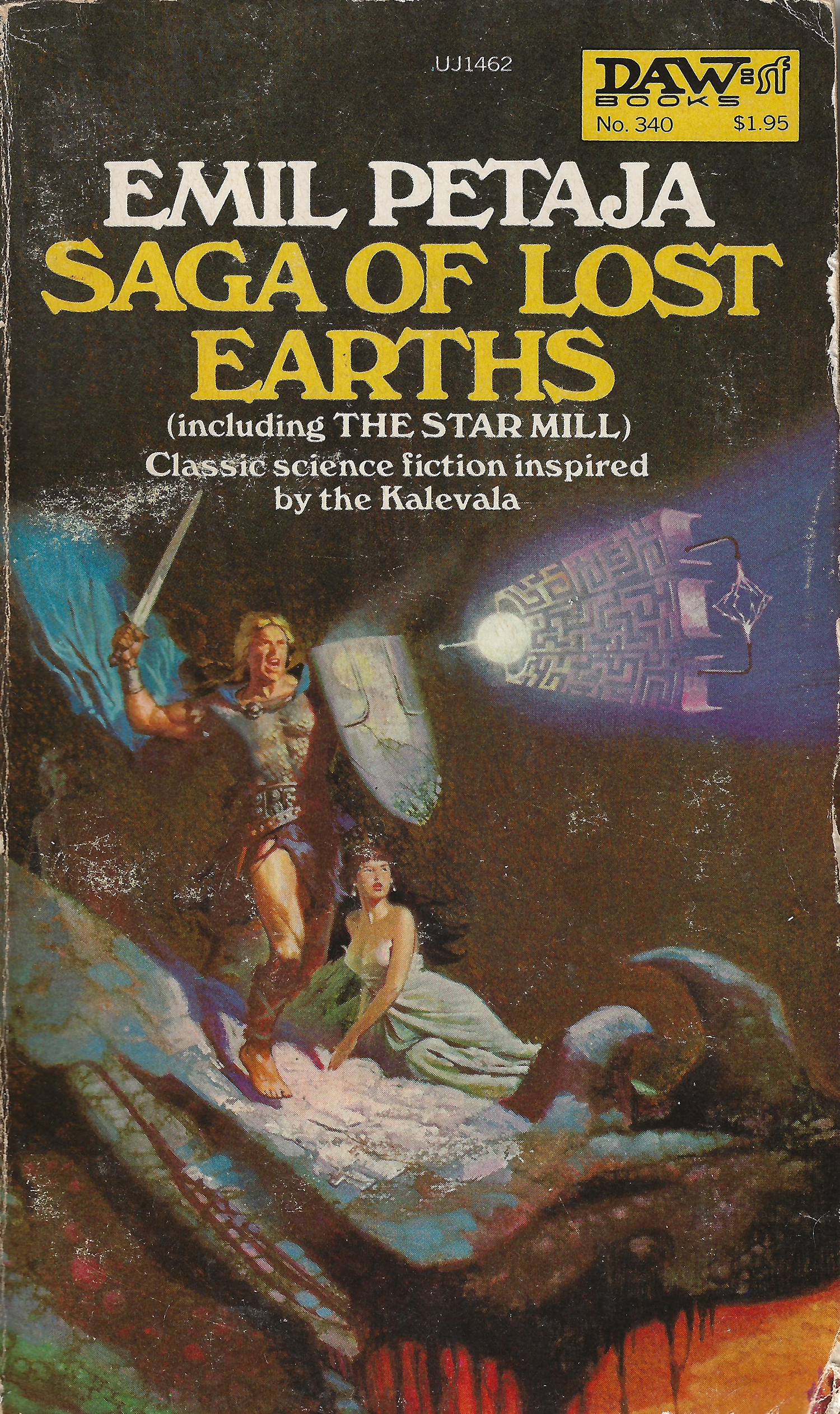
Saga of Lost Earths
Author: Emil Petaja
Published: Originally in 1966 by Ace; May, 1979 by DAW
Cover Artist: Jordi Peñalver (1979 DAW edition)
Publisher Blurb (DAW edition): Petaja's Kalevalan Classics
"The Force is from outside our time and space, from outside anything we can humanly comprehend. I Conceive of a great machine somewhere -- alien beyond human thought -- sending out tendrils like electric impulses.... In the days of the Kalevalan heroes, actually before our present cycle of civilization began, the Force was thrust in on Earth...."
Such is the theme of the first novel of Emil Petaja's classic science fiction series based on the brilliant epic of Finnish lore, the Kalevala. A mighty saga of heroes and witches, of beings from the stars and beyond the stars, of powers that came to Earth and shaped humanity.
A student of the Kalevala, Petaja has created from its mind-stunning material a cycle of four novels -- science fiction fantasy adventure of the highest order -- retelling in the eyes of modern scientific conjecture the great worlds-shaking events that may be concealed by the folklore of an ancient and mysterious people.
SAGA OF LOST EARTHS, with which is included a second complete novel, THE STAR MILL, brings two of these unique sf classics back to today's modern sf readers.
Notes: This novel and its sequels are based on the Finnish epic Kalevala written/compiled by Elias Lönnrot and drawn from Karelian and Finnish folklore and mythology.
The DAW version of this book includes Saga of Lost Earths and its sequel The Star Mill.
This book contains Finnish names, so I feel compelled to write a quick note here on language. Finnish is a Uralic language; it is not even closely related to Scandinavian languages, nor is it related to Russian. Finland itself is not a part of Scandinavia. Finnish spelling is phonetic, and words are pronounced with an emphasis on the first syllable. The author's last name is pronounced like PET-ah-ya.
As for notes on the story itself...
This is a pretty typical Male Adventure Fantasy formula, with nothing particularly to recommend it. We have the generic male protagonist who is struggling in his society for the familiar reasons of being too macho and too independent for his culture's over-corrective psychological intervention against war and violence etc. Our generic male protagonist, on account of his special qualities, is met by a beautiful generic woman who invites him on a secret and important mission that will save the world. Although our generic male protagonist treats beautiful generic woman rather poorly, she eventually proclaims her love for him without any romantic/sexual chemistry or narrative need. Here we also have generic evil alien, who feeds off mental energy, and is able to psychically exert control over human beings through contact with a newly discovered rare earth metal coming out of a mine in Finland. Material from Kalevala is brought in at random. The story is not particularly well-constructed or engaging, the writing is juvenile and sloppy, none of the characters are particularly likable or interesting. And just to be safe, Petaja threw in a few other unpleasant tropes, too, like having a specific race (in this case the Finns) being uniquely special. Overall this is a badly dated story. Even with the outdated gender roles, the actual Kalevala is a more rewarding and enchanting read, and I recommend reading it instead (Keith Bosley's English translation is my favorite, but Eino Friberg's is also good).
All that said, at least Petaja seems to have read and loved the Kalevala; this series is a very imperfect, aged homage to something he seems to have cared deeply about-- namely, Finnish culture, which he was exposed to as a child or grandchild of Finnish immigrants.
While I would find it offensive if it had been written today, if for no other reasons than the superior-race trope and the woman-character-as-accessory trope, it's very thoroughly a product of its time and on the balance it's certainly less offensive than Heinlein, so there's that.
Summary: Carl Lempi is unhappy in his role as a menial office worker in a megalopolis where an ambiguous leadership of psychologists has succeeded in rooting out violent impulses and a want for war. Carl is bored, since he's too macho (being hyper-masculine is important for the story, after all, how else could he be a parallel for the warrior Lemminkäinen?) for any such society. He has so far been allowed his continued, unsatisfying existence without interference because the government has an eye on him for his unusually strong psychic abilities.
While on his lunch break, lamenting his boring life, a beautiful young woman named Silia pulls Carl out of his humdrum existence to whisk him off to the underground, where he is introduced to her eccentric uncle Dr. Enoch and some other top brass. Here he learns about the invasion of an evil alien race, which is acting through the medium of a newly discovered rare earth metal. Whenever a human being comes in physical contact with this metal-- excepting the Finns who work the mine-- the alien entities are able to take command of the person's emotional state and impulses, and lead them to kill themselves. Dr. Enoch believes this is not humankind's first encounter with this alien entity, and that its previous attack on the human race can be divined from the evidence of the Kalevala along with the rich mythology of Finland. Why all this should be and how to stop the invasion are questions left in Carl's incapable hands, and he's to be sent off to Finland to investigate. Why Carl? Well, aside from his personal high psychic ability, he's also of Finnish ancestry, and he can tap into the mythology of this psychically "superior" race to defend himself: throughout the novel, he is compared with Lemminkäinen and expected to become the embodiment of this vain Kalevalan warrior.
Upon arriving in Finland, we learn that the whole world is not actually an ecumenopolis as the introduction might lead a reader to believe... Finland is apparently exempt from the development of stifling cities, left wild and sparsely populated. (This leaves me to wonder why Carl Lempi, so depressed in his role in his city and knowing his problems would be alleviated in a freer environment, not to mention also being of Finnish descent and a fluent Finnish speaker, never thought of immigrating to Finland. Perhaps there's some unmentioned political or legal reason why he couldn't consider it previously. I'm also left to wonder why a man who is intensely afraid of the dark and has never seen a wild place should have any woodcraft or nature sense. I guess it comes from his spiritual connection with Lemminkäinen.)
We are introduced to a helper who takes his name from the Kalevala, Kullervo, and he's ugly, so he must therefore be evil and an agent of the aliens. Carl, Enoch, and Kullervo visit a sauna for a chat, and the sauna catches fire (Kullervo's influence). Enoch perishes in the fire for no particular reason after serving no particular purpose on the journey. A local Finn agrees to guide Carl on his quest to find the legendary smith Ilmarinen, and Carl et al are off on an adventure into the Finnish wilderness. Kullervo offs the guide and disappears, leaving Carl to complete his search alone. A misadventure or two and he's reunited with Silia, who has tracked him in secret to look after him. Carl and Silia find Ilmarinen, who forges a sword for Carl. Carl orders Silia to stay with Ilmarinen while he sets off by himself to confront the evil aliens. Silia sneaks after him, declares her love, he bullies her, etc. Shortly after, Carl and Silia slip out of the real world and into the mythic world, where Carl forgets himself as Carl and knows himself as Lemminkäinen. Some material from the Kalevala is acted out here; in one episode, Carl must save Silia from marriage to evil incarnate; Carl comes to the realm of the aliens where Silia has been abducted to; Carl and Silia reunite and discover the aliens to be empathic predators who rely on the emotional output of their prey for sustenance; Carl defeats the leader; The End.