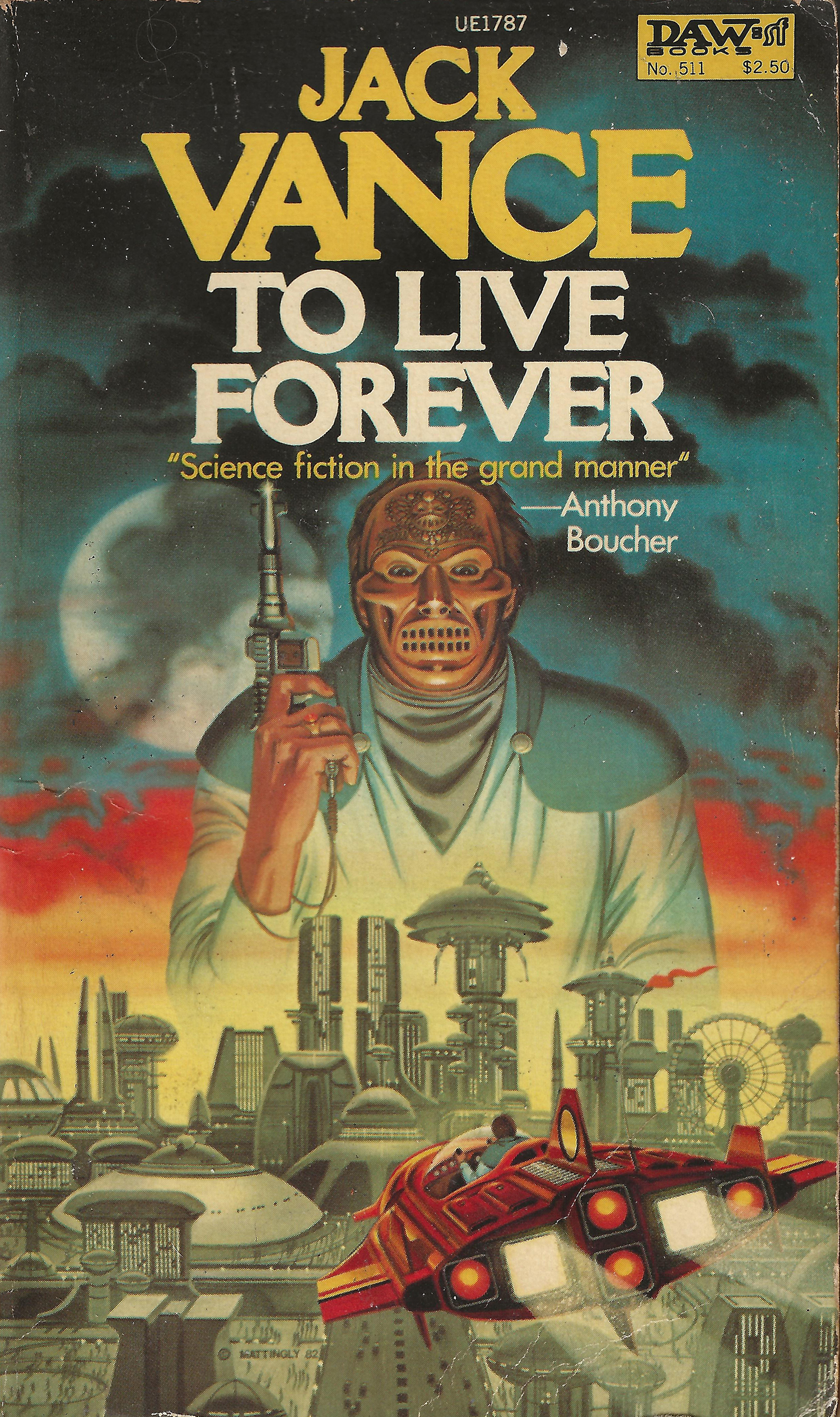
To Live Forever
Author: Jack Vance
Published: Originally 1956 by Ballantine; 1976 by Ballantine; December, 1982 by DAW; in the 1990s/2000s in the Vance Integral Editions as Clarges
Cover Artists: Richard M. Powers (1956 Ballantine edition); David B. Mattingly (1982 DAW edition)
Publisher Blurb (DAW edition): Garven [sic] Waylock had waited seven years for the scandal surrounding his former immortal self to be forgotten. He had kept his identity concealed so that he could once again join the ranks of those who lived forever. He had been exceedingly careful about hiding his past.
Then he met The Jacynth.
She was a beautiful 19-year old, and Garven wanted her. But he recognized that a wisdom far beyond her years marked her as one who knew too much about him to live.
As far as she was concerned, death was a mere inconvenience. But once The Jacynth came back, Garven Waylock's life would be an everlasting hell!
Notes: Stand-alone novel. This one gets off to a slightly slow start as concepts and world-building elements are introduced, but quickly picks up the pace and starts exploring interesting questions in this far-future Earth where humans have a chance to live forever. Through Gavin/The Grayven, Vance explores the limitations of a meritocratic society, of making life-and-death choices on the basis of static computations, of encouraging a society to be intensely productive on very slim promises. On the one hand, people unable to meet the aggressive demands of seeking slope increasingly lapse into catatonia, spending their limited lifespans in psychiatric hospitals where they are treated as non-consenting test subjects to those doctors and therapists determined to make discovery of medical treatments their entry into the next class level towards immortality. On the other, since chances for achieving the immortal class are narrowing as time passes and limited slots remain, those pursuing entry are really only successful if they can be ruthless and tireless, fully dedicated to the project while also having the aptitude to do something deemed novel and important. Close relationships seem particularly impossible in this society; partners and friends move through classes at different rates, and one can't change one's class by marrying up. You might come home and find that your spouse is missing, and you might pursue his whereabouts and learn that the assassins have come for him. Grief is suppressed here, if it even exists. Because your way up the ranks might involve stealing someone else's ideas, blaming someone else for your mistakes, or sacrificing your time entirely to the creation of a valuable product, there is very little ground for trusting or growing attached to others, until, of course, you're immortal. And by then, you're socially dysfunctional. Meritorious only when it comes to achievements in the arts and sciences, the class of immortals is made up of the extremely self-centered and most ambitious of society.
I particularly like Gavin as a character in this story; while he's written to be sympathetic (in a sense), he's also abominable. He's branded a Monster in the novel, and that's what he is: he has no compassion or mercy, he's scheming and selfish, and he's completely ruthless. At the same time, he's always logical and sane in context of the society he's a product of, and he is a sort of personification of the hypocrisy of his world... which is, of course, a fictional extension of our own.
- Phyle - social class, which is connected with allotted lifespan; word comes from the Greek, where it means tribe or clansmen, and was used as an organization or administrative term (wiki page).
- Glark - someone who has opted out of the class system provisioned by the Fair-Play Act, living out a normal lifespan while aging, and provided with healthcare except for specific longevity and senescence treatment. Average age at death is 82. About a fifth of the population. The etymology is in-universe and postulated to come from "gay lark."
- Base aka Brood - upon applying for entry into the class system, an individual starts off in the lowest class, colloquially called brood. There are no advantages conferred at this stage except for being assigned a slope, allowing one the ability to move to the next level with enough achievement. A person's life at this stage cannot exceed 82 years.
- Second aka Wedge - medical treatment for senescence is granted and the person 'locks in' at the age they are at treatment. Life span cannot exceed 92 years.
- Third aka Arrant though the colloquial term in this case is rarely used by people and not really mentioned again - no further medical treatments; life span cannot exceed 108 years.
- Fourth aka Verge - no further medical treatments; life span cannot exceed 128 years.
- Fifth aka Amaranth - an individual is cloned with a number of additional reserve clones in empathic synchronicity with the original personality; the individual is allowed somatic genetic modification to meet cosmetic desires; the individual is granted medical immortality. In addition, the individual is enrolled in the society of Amaranth, placing them in a very prestigious social class. The word amaranth aka amaranthus refers to a genus of plants, but in ancient Greek the word stems from the word for immortal and it is culturally associated with longevity (wiki page).
- A person's progress towards the next class is calculated with a function which takes into account their lifespan so far and their contributions to society and is represented by the calculation's slope on a graph. If the slope stops rising, the person is taken away by assassins to be euthanized.
Summary: In a distant future where humans have discovered how to live forever but not how to curb population overgrowth, immortality is awarded on a meritocratic basis to those who have "earned" it through the nebulous idea of contribution to humanity-- which covers the arts, science, and interstellar exploration. In this extremely competitive context, society revolves around the concept of slope-- that is, the slope produced by a function which calculates a person's progress through phyles, or social classes associated with longevity, in an effort to achieve not only immortality, but also safety: each class until the last comes with a time limit on one's lifespan. Run out of slope, and get a visit from the black-clad assassins. But achieving immortality is itself an ethical conundrum, because whenever a new member is welcomed into the deathless class, slope must be recalculated for those left behind, shortening their lifespans.
In this cutthroat, workaholic culture whose only outlet is the party-city of Carnevalle, Gavin Waylock-- formerly The Grayven Warlock, immortal-- is in a unique position: shortly after achieving immortality, his involvement in a brawl leads to the death of another immortal... a temporary death, for each immortal has multiple cloned bodies in empathic synchronicity with the active personality, but a heinous crime none the less. His state-sponsored death is called for, but he escapes and remains in hiding for seven years until his old identity is officially and legally purged. From there, he intends to work his way back up to the society he has been ejected from, pretending to be his own relict: a leftover clone with no empathic connection to the former identity. Just as he's prepared to re-enter the workforce and pursue this goal, he meets The Jacynth, also newly immortal, and with the knowledge at hand to expose him not as a relict but as the original Grayven Warlock. To protect himself, he has her killed, knowing that she will soon inhabit one of her cloned bodies: herself again, but not retaining the memory of their ill-fated meeting, which has not had time to be synchronized to her clones. What he doesn't count on is The Jacynth's intense regard for the sanctity of her own life, and her willingness to track down her killer and do whatever it takes to exact revenge. Waylock, a product of his time, will go to any length to protect himself and his immortality, regardless of who else must die along the way. As The Jacynth becomes increasingly intrusive in his own life, thwarting his attempts to progress through the phyles, Gavin grows desperate and sacrifices people around him ruthlessly to evade her. This culminates in his release of clones, leaving the immortal class with two major decisions: either let Gavin resume his life as an immortal or be prepared for further clones to be released; and, more pressingly, should those clones coming to life be part of the immortal class right away, or must they start from the bottom class and work their way up? Gavin and clones alike are granted entry to the amaranth phyle society, and these thousands of new members drastically alter slope for those still striving below them, inciting rebellion as people are rounded up by the assassins. Meanwhile, The Jacynth catches up to The Grayven Warlock and kills him, not realizing that his own, empathized clone is ready to take his place. In the aftermath, The Grayven escapes with an interstellar exploratory party, positing that the way for all humanity to achieve immortality is by claiming new worlds.
External links:
To Live Forever: Vance writes about things that fascinate me
FORGOTTEN BOOKS #232: TO LIVE FOREVER By Jack Vance
To Live Forever aka Clarges by Jack Vance